
Intermediate
What the pattern's own author called it. Nothing here is graded again.
 Crochet·Rituals
Flowers & Appliqué 4 Laid out for paper No account, no download
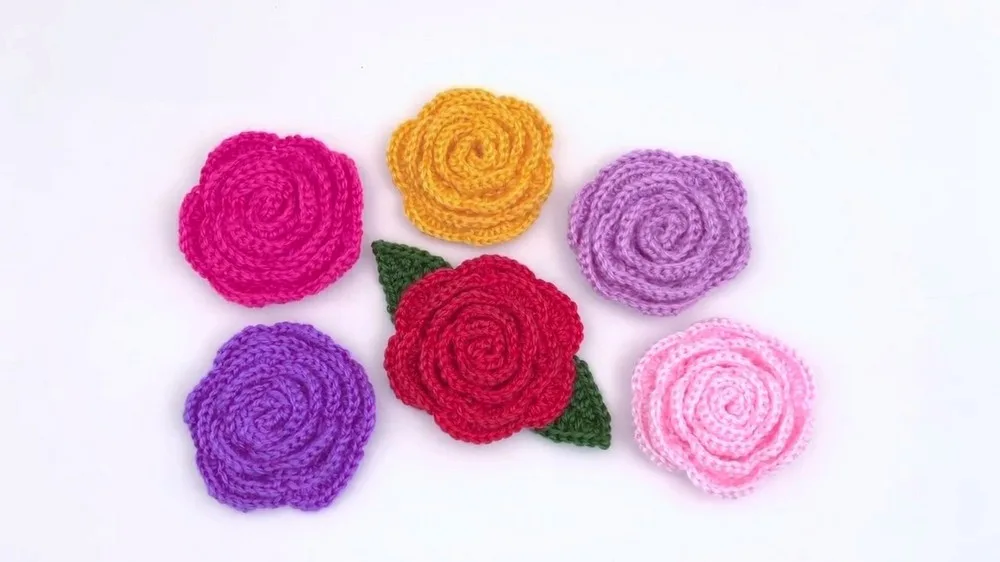
Rolled rose brooch, 4 rows, worked flat on a chain-81 base with any hook to match your yarn.
Crochet Rituals · retyped from the source and laid out for print · added 2 Oct 2026
What the pattern's own author called it. Nothing here is graded again.
What the sample was worked in. Any weight works; the size moves with it.
Each one is typed out whole and gets its own line.
This brooch starts as a single long strip, chained to 81 and built up in four rows on the same piece — no joining in the round, no separate petals to sew on later. The first two rows set a flat, curved base; the last two raise shell-stitch petals along one long edge, shorter near the center and taller toward the outer edge. Once the last row is secured, the whole strip rolls inward on itself to form the rose. Have your yarn, a hook sized to it, scissors, and a yarn needle on hand before you start — nothing else is needed.
Listed by the pattern's own author, in their words.
Tie a slip knot and chain 81; chain 1 (turning chain), skip the first chain from the hook, then single crochet in the next chain; single crochet in each chain across.
Turn the piece over (if you didn't work into the back bumps initially, now switch so that the top of the stitches are at the bottom for a thicker and nicer look); chain 1 and slip stitch into the first stitch; chain 3 (counts as a double crochet); double crochet in the next stitch; increase by putting two double crochets in the next stitch; follow this pattern across: one double crochet in each of the next two stitches, then two double crochets in the next stitch, repeatedly; by the end, your piece should curve like a semicircle.
Turn the piece over to create the rose petals using the shell motif pattern; chain 1, skip one stitch and put 4 half double crochets into the next stitch to create half of a petal; repeat the 4 half double crochets in the following stitch (completing the petal); skip one stitch and secure with a single crochet in the next stitch (one petal completed); skip one stitch, then make 4 half double crochets in the next stitch for the first half of the next petal, followed by 4 half double crochets in the subsequent stitch for the second half, skip one stitch and secure with a single crochet; after making two half double crochet petals, increase the height of petals by using double crochet instead of half double crochet for the next petals; skip one stitch, then make 4 double crochets in the next stitch, and so on, as you have been doing with the half double crochets; secure each petal with a single crochet after skipping a stitch; continue with 8 double crochet petals.
After the midpoint, start increasing the size of the petals for the outer part of the rose; skip one stitch, then make 3 double crochets, followed by 3 extended double crochets, and another 3 double crochets in the next stitch; to make an extended double crochet: yarn over, insert the hook into the stitch, pull up a loop (three loops on hook), yarn over and pull through one loop (the extended loop), then complete as you would a regular double crochet; skip one stitch and secure the extended petal with a single crochet; repeat this sequence around.
| Rounds | 4 |
|---|---|
| Level | Intermediate |
| Time | 4-6 hours |
| Yarn | Worsted |
The increases in Row 2 — one double crochet, one double crochet, two double crochets, repeated across — are what turn a straight foundation row into the curved semicircle the petals sit on.
The piece is worked flat rather than in the round because it is meant to be rolled afterward: each row adds a taller band of petals along one edge, and rolling the finished strip is what turns a flat shell pattern into a dimensional rose.
| Foundation and base curve (Rows 1-2) | about 30-40 minutes because it is a long chain-81 row plus one shaping row |
|---|---|
| Shell petals (Rows 3-4) | about 2-3 hours because each petal is built from multiple stitches into one base stitch and needs a steady skip-one rhythm |
| Rolling and finishing | about 1 hour because the roll must be pinned, stitched, and reinforced with extra needle passes for stability |
Every one was taken by whoever published the pattern, in the order the source listed them.


These answers came from whoever first published the pattern, kept word for word.