Skip to the patterns
Crochet·Rituals
Menu

Amigurumi 8 Laid out for paper No account, no download

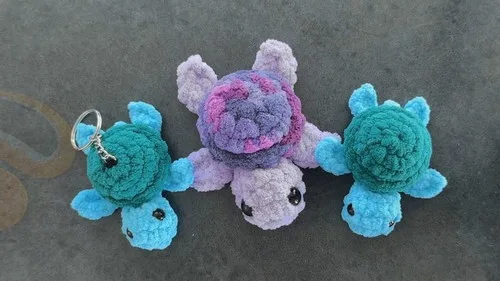
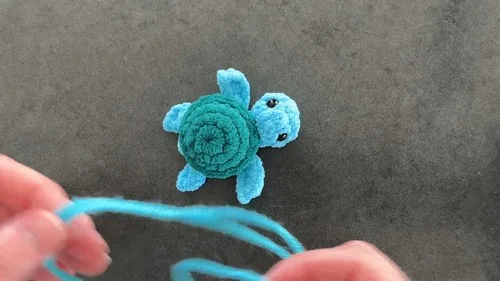
Small crochet turtle keychain pattern with shell and head

Amigurumi turtle keychain: 4-round head, 4-round shell, 3.75mm hook, safety eyes.

Jump to the rounds Pin it
Small crochet turtle keychain pattern with shell and head
Amigurumi · Worsted
Skill
Intermediate
Time
4-6 hours
Yarn weight
Worsted
Hook
3.75 mm
Rounds
8

Intermediate

What the pattern's own author called it. Nothing here is graded again.

Worsted

What the sample was worked in. Any weight works; the size moves with it.
8

Each one is typed out whole and gets its own line.

This turtle keychain builds from two small parts worked separately, then joined: a four-round head shaped by magic ring, single crochet increases, and a front-loop decrease crown, and a four-round shell that grows from 8 to 16 stitches before finishing flat in back loops only. Shell stitches around the shell's edge form the flippers and tail once the head is attached. Before starting, have plush yarn in two colors, a 3.75mm hook, 8mm safety eyes, stitch markers, stuffing, and a keychain ring on hand.

Common mistakes and their fixes

Losing the marked back loop
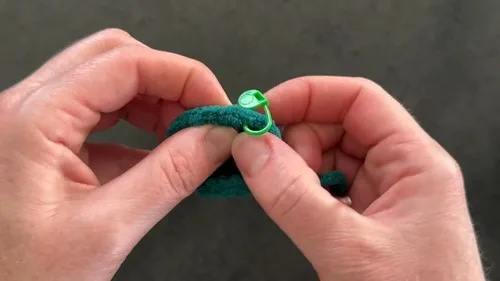
Place the stitch marker in the back loop before starting Round 5, and check it after every few stitches, since the front-loop-only round makes it easy to drift into working both loops.
Closing the head before stuffing enough
Add stuffing before working the six front-loop-only decreases in Round 4. Once that round is complete, the opening is too small to add more.
Misplacing safety eyes
Set eyes on either side of the head during Round 3, using markers to check spacing before pressing the posts through, since eyes are permanent once secured.

The materials list

  1. Plush yarn in two colors (one for shell, one for head/body)
  2. Crochet hook (3.75mm recommended)
  3. 8mm safety eyes
  4. Stitch markers
  5. Stuffing
  6. Yarn needle
  7. Scissors

Optional

  1. Acrylic yarn and keychain ring

Listed by the pattern's own author, in their words.

Key to this pattern, 3 short forms

Head

Round 1

Magic ring, 8 single crochet (sc)

Round 2

Repeat (1 sc, 1 inc) x4 — 12 sts

Round 3

12 sc Attach safety eyes on either side of the head

Round 4

6 decreases (front loop only) Finish off with a slip stitch, cut yarn, and tuck the tail inside

Shell

Round 1

Magic ring, 8 sc

Round 2

1 inc in each stitch — 16 sts

Rounds 3–4

16 sc

Round 5

Front loops only Mark first back loop, chain 1 through front loop, then 16 sc in front loops onlyFinish off, cut yarn, and blend the last stitch using the invisible join method

Assembly, in order

Step 1Cut yarn, leave a tail
Step 2Cinch remaining hole using front loops only with a yarn needle
Step 3For tail: Come out at back, ch 4, pull through and fold
Step 4Secure with a knot and hide yarn tail inside

Check these before you start

  • Use a 3.75mm hook with plush yarn to keep stitches tight enough that stuffing does not show through the fabric.
  • Mark the back loop on the shell before working Round 5, since the front loops and back loops are worked separately and easy to mix up mid-round.
  • Stuff the head firmly before closing Round 4's front-loop-only decreases, since access shrinks fast once those six decreases are worked.

On one line

Rounds8
Parts2
LevelIntermediate
Time4-6 hours
Hook3.75 mm
YarnWorsted

Set-up

  • Confirm you have plush yarn in two distinct colors on hand — one is not enough, since head and shell are worked separately.
  • Set aside stitch markers for the marked back loop on the shell and for placing safety eyes accurately in Round 3 of the head.
  • Check that your 8mm safety eyes and keychain ring are within reach before you begin the head, since eyes go in partway through, not at the end.

Finishing

  1. Stuff the head firmly, then close Round 4 with the front-loop-only decreases, finish off with a slip stitch, cut yarn, and tuck the tail inside.
  2. Cinch the shell's remaining hole using the marked front loops with a yarn needle, then cut the yarn leaving a tail for shaping.
  3. Bring the tail out at the back of the shell, chain 4, pull through and fold to form the keychain loop, secure with a knot, and hide the yarn tail inside.

Construction

The shell's increases are front-loaded: all growth from 8 to 16 stitches happens by Round 2, so Rounds 3 and 4 work even and simply build height before the front-loop round begins.

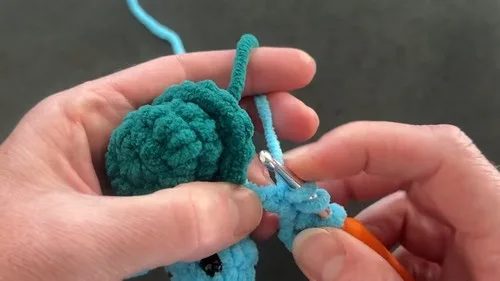
Round 5 of the shell is worked in front loops only after marking the back loop, which leaves a clean ridge of back loops free for later assembly around the shell's edge, including the head, flipper, and tail attachments.

Time per section

Headabout 20-30 minutes because it is only 4 rounds, but placing the safety eyes in Round 3 and stuffing before the Round 4 decrease slows the pace
Shellabout 30-40 minutes because it runs 5 rounds total with an increase round and a front-loop-only finishing round that needs careful loop tracking
Attaching head, flippers, tail, and keychain loopabout 30 minutes because each shell stitch attachment point is worked individually, and the chain-and-fold keychain loop takes a steady hand

Photographs of this one

Every one was taken by whoever published the pattern, in the order the source listed them.
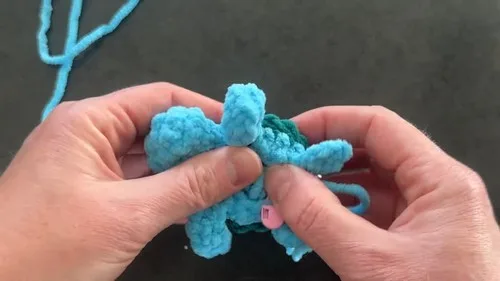
Small crochet turtle keychain pattern with shell and head — photo 2
Small crochet turtle keychain pattern with shell and head — photo 3
Small crochet turtle keychain pattern with shell and head — photo 4
Small crochet turtle keychain pattern with shell and head — photo 5

Common questions

When should safety eyes go in on the head?
Place them during Round 3, once the head has reached 12 single crochet stitches and before the Round 4 decrease closes the opening. Waiting until after Round 4 makes it too tight to set the posts evenly.
Can the head and shell be made in the same color?
Yes, though the pattern is written with two colors, one for the shell and one for the head and body, to make the finished turtle read clearly. A single color still works structurally since the parts are shaped identically either way.

These answers came from whoever first published the pattern, kept word for word.