Confident Beginner to Intermediate
What the pattern's own author called it. Nothing here is graded again.
 Crochet·Rituals
Blankets & Throws 7 Laid out for paper No account, no download
Striped cotton throw: 167 dc foundation, textured cluster rows, sc border, 5 mm H-8 hook.
Crochet Rituals · retyped from the source and laid out for print · added 17 Oct 2026
What the pattern's own author called it. Nothing here is graded again.
What the sample was worked in. Any weight works; the size moves with it.
Each one is typed out whole and gets its own line.
This cotton throw starts with a foundation chain of 169 stitches worked in Color A, producing 167 double crochet stitches in the first row, worked flat in rows from the bottom edge upward. Plain rows alternate with a textured section where small clusters interrupt an otherwise even double crochet fabric, and the whole piece finishes with a single crochet border worked in two rounds, three stitches placed in each corner. Have about 2,000 yards of worsted weight cotton in four colors on hand, along with a 5 mm hook, a yarn needle, and blocking mats, before starting the first row.
Listed by the pattern's own author, in their words.
Key to this pattern, 8 short forms
Construction Notes The blanket is worked from the bottom edge upward in rows. The turning chain does not count as a stitch. Change colors at the beginning of selected rows to create soft horizontal stripes.
With Color A, ch 169.
Dc in the 3rd ch from hook and each ch across. Turn. (167 dc)
Ch 2, dc in each stitch across. Turn. (167 dc)
Ch 2, dc in first 8 sts, *textured cluster in next st, dc in next 9 sts; rep from * across. Turn.
Ch 2, dc in each stitch across. Turn. (167 dc)Repeat Rows 3 and 4 three more times for a textured section of 8 rows.
Join Color A in any corner. Ch 1, work sc evenly around the entire blanket edge. At each corner, work 3 sc in the corner stitch. Join with a sl st to the first sc.
Ch 1, sc in each stitch around, placing 3 sc in each corner stitch. Fasten off and weave in all ends.
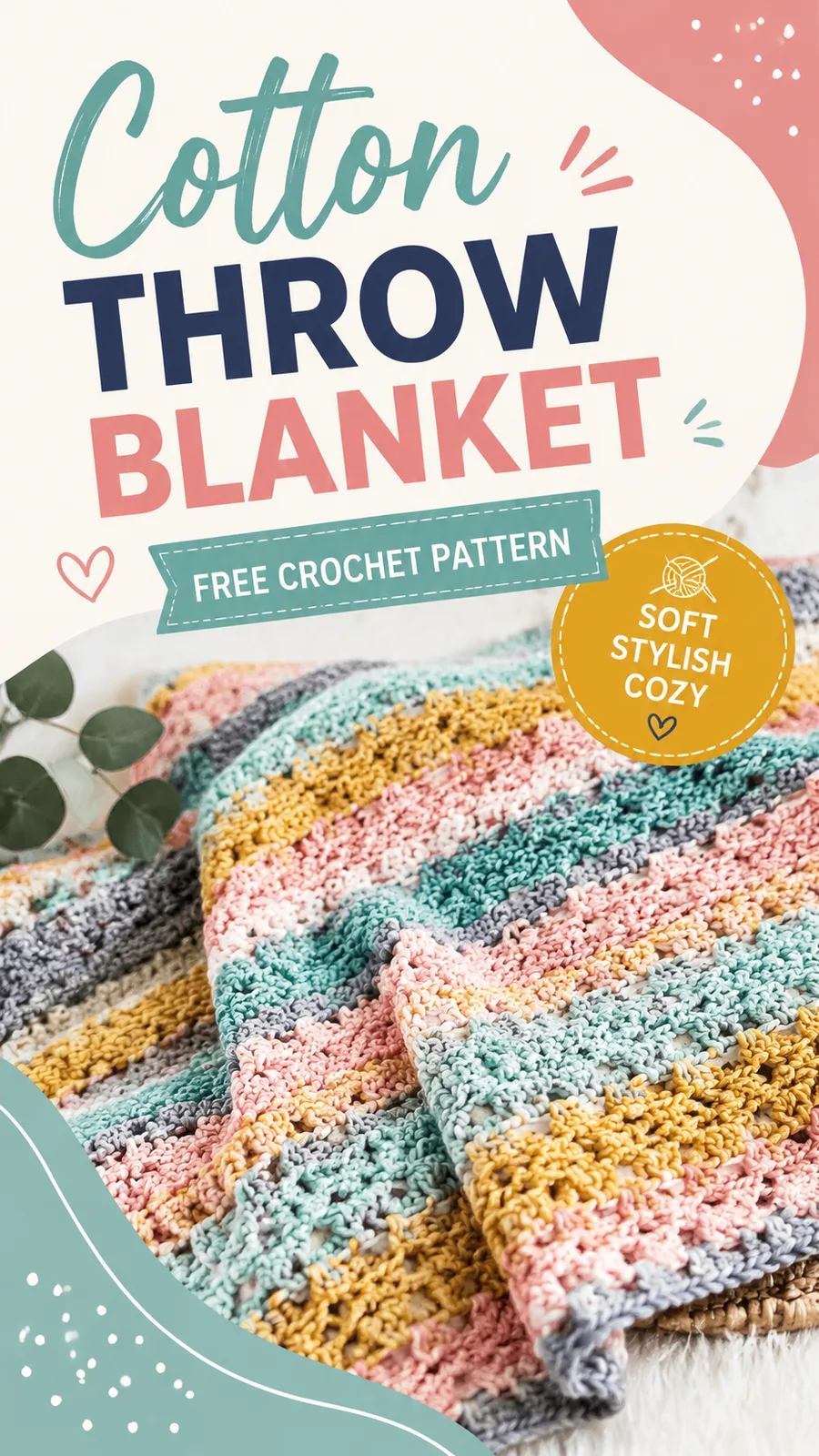
Pastel Waves Cotton Throw Blanket
This original crochet blanket pattern creates a soft rectangular throw with alternating textured stripes and subtle open sections inspired by lightweight cotton crochet designs.
Skill Level Confident beginner Finished Size Approximately 42 x 52 inches (107 x 132 cm)
Yarn Worsted weight cotton or cotton blend yarn, approximately 2,000 yards (1,830 meters)
Hook 5 mm US H-8 crochet hook Gauge 16 double crochet stitches x 8 rows = 4 x 4 inches (10 x 10 cm)
Terminology US crochet terms
Textured cluster: In the same stitch, work (dc, ch 1, dc). This creates a small open texture section while maintaining a flexible blanket fabric.
Rows 1 to 12: Color A Rows 13 to 24: Color B Rows 25 to 36: Color C
Rows 37 to 48: Color D Repeat this four-color sequence until the blanket measures approximately 50 inches (127 cm).
Continue working the established stitch pattern until the blanket reaches the desired length. Finish after completing a solid double crochet row.
| Rounds | 7 |
|---|---|
| Parts | 5 |
| Level | Confident Beginner to Intermediate |
| Time | 8-12 hours |
| Hook | 5 mm |
| Yarn | Worsted |
The textured cluster in Row 3 is placed after the first 8 stitches and then every 9 stitches across, which centers the clusters evenly rather than running them edge to edge.
The border round places 3 single crochet stitches in each corner stitch, which adds the extra fabric a flat, row-built rectangle needs to turn a square corner without puckering.
| Foundation row and first plain rows | about 45-60 minutes, because 167 double crochet stitches per row takes longer to establish than later repeat rows. |
|---|---|
| Textured section (Rows 3-4 repeated four times) | about 2-3 hours, because the cluster count must be checked across 167 stitches on every cluster row. |
| Border round | about 30-40 minutes, because the single round of single crochet only needs careful corner placement at four points. |
These answers came from whoever first published the pattern, kept word for word.