Skip to the patterns
Crochet·Rituals
Menu

Bags 15 Laid out for paper No account, no download

Colorblock macrame yarn tote bag pattern for every skill level

Crochet tote: flat base, 11-round body, 100-ch handles. 4.5mm hook, macrame yarn.

Jump to the rounds Pin it
Colorblock macrame yarn tote bag pattern for every skill level
Bags · Worsted
Skill
Intermediate
Time
4-6 hours
Yarn weight
Worsted
Hook
4.5 mm
Rounds
15

Intermediate

What the pattern's own author called it. Nothing here is graded again.

Worsted

What the sample was worked in. Any weight works; the size moves with it.
15

Each one is typed out whole and gets its own line.

Crochet tote: flat base, 11-round body, 100-ch handles. 4.5mm hook, macrame yarn.

Common mistakes and their fixes

Losing count in the cluster spacing
Place a stitch marker at the start of every cluster group as you work the body rounds. This makes it easy to check that exactly two single crochets are skipped between clusters.
Uneven tension between yarn colors
Test each of the three macrame yarn colors on your swatch, since dye lots or spin can vary slightly in thickness. Adjust hook grip rather than hook size to match tension across colors.
Handles twisting after attachment
Lay the 100-stitch chain flat before slip stitching along it, checking it has not rolled. A twisted handle chain will show as a spiral once slip stitched solid.

The materials list

  1. Macrame yarn in three colors (purple, yellow, and white)
  2. 4.5 mm crochet hook
  3. Large needle
  4. Small needle

Listed by the pattern's own author, in their words.

Key to this pattern, 10 short forms

Body

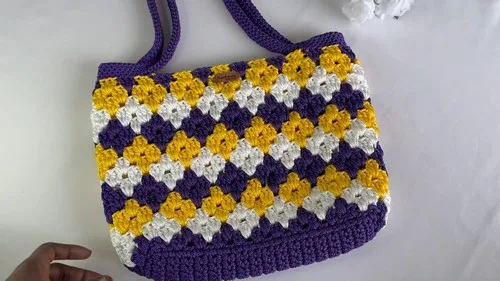
The bag's base is worked with simple single crochet stitches, while the body is created with beautiful clusters of double crochet, allowing for a lightweight yet durable finish.

Round 1

Crochet one round of single crochet around the base.

Round 2

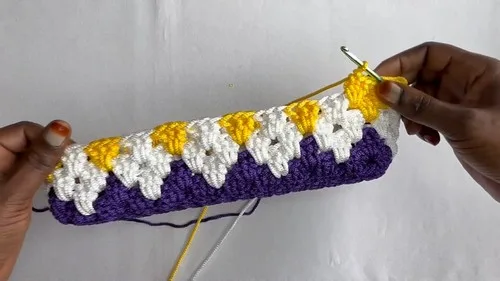
Create the body by making clusters of three double crochets, skipping two single crochets between each cluster.

The pattern alternates colors for a flower-like effect:

Row 1

Three double crochets (use purple).

Row 2

Alternating white and purple.

Row 3

White only.

Row 4

Alternating yellow and white.

Row 5

Yellow only.

Row 6

Alternating yellow and purple.

Row 7

Purple only.

Row 8

Alternating white and purple.

Row 9

White only.

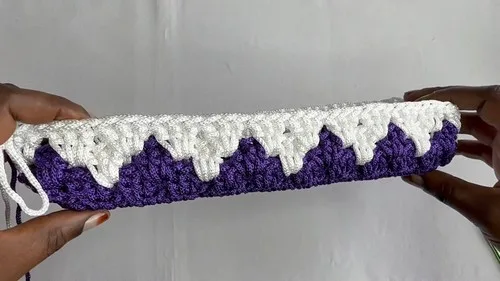
Base

Round 1

Start with a multiple of three chains, plus one. The demonstrator begins with 10 chains.

Round 2

Crochet single crochet rows until you have 33 rows.

Handles

Round 1

Create chains of 100 stitches.

Round 2

Slip stitch along the chains to make a sturdy strap.

Assembly, in order

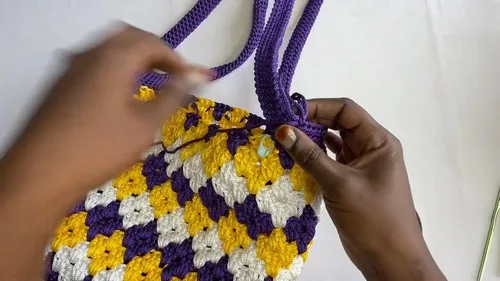
Step 1Attach the handles to the bag.
Step 2Fasten off the yarn and sew in the ends.
Step 3Add a tag to complete the bag.

Check these before you start

  • Macrame yarn has less give than standard worsted, so keep tension slightly looser than usual through the double crochet clusters or the body will cup instead of sitting flat.
  • The 33-row base determines the finished width of the bag, so keep single crochet stitches consistent in height across all 33 rows to avoid a base that bows on one side.

On one line

Rounds15
Parts3
LevelIntermediate
Time4-6 hours
Hook4.5 mm
YarnWorsted

Set-up

  • Read through the full Body section before starting it; the cluster pattern shifts which color leads every few rows, and knowing the sequence ahead of time keeps the flower effect even.
  • Check that your chain of 10 for the base is a true multiple of three plus one — recount before turning to Round 2, since an off count will throw the single crochet rows out of alignment.
  • Work a short test swatch with your macrame yarn and the 4.5 mm hook to confirm the fabric holds its shape; macrame yarn behaves differently from standard worsted and can crochet looser than expected.

Finishing

  1. Weave in all yarn ends from the base, body, and handles using the large needle, running each tail through several stitches on the wrong side before trimming.
  2. Attach the handles to the top edge of the bag, positioning them evenly opposite each other so the tote hangs balanced when carried.
  3. Fasten off the working yarn, sew in the last ends with the small needle, and add a tag to complete the bag.

Construction

The base is worked flat first, in rows rather than continuous rounds, which produces the oval floor of the bag before the body is picked up around its edge — this keeps the bottom flat instead of curved.

The double crochet clusters in the body are spaced with two skipped single crochets between each group, and it is this gap, repeated with shifting colors, that creates the flower-like openwork rather than a solid fabric.

Time per section

Baseabout 45 minutes, because 33 rows of single crochet in a straight sequence go quickly once the starting chain is set
Bodyabout 2.5 to 3 hours, because 11 rounds of clustered double crochet with three alternating colors require frequent color changes and cluster counting
Handles and finishingabout 1 hour, because the 100-stitch chains and slip stitch pass are simple but attaching, weaving in ends, and adding the tag take steady time

Photographs of this one

Every one was taken by whoever published the pattern, in the order the source listed them.
Colorblock macrame yarn tote bag pattern for every skill level — photo 2
Colorblock macrame yarn tote bag pattern for every skill level — photo 3
Colorblock macrame yarn tote bag pattern for every skill level — photo 4

Common questions

Can the three colors be swapped for a different palette?
Yes, the pattern works with any three colors of macrame yarn since the structure relies on alternating rows rather than a specific hue. Keep the same three-color rotation through the body rounds to preserve the flower-like effect.
Why does the body use clusters instead of solid double crochet?
The clusters of three double crochets, skipped by two single crochets, create open gaps that let the color changes read clearly as a pattern rather than blending together. Solid double crochet would hide the alternating purple, yellow, and white sequence.
How long should the handle chains end up once slip stitched?
Each handle starts from a chain of 100 stitches, then a second round of slip stitch is worked along that same chain to make it sturdy. The slip stitch pass does not add length, only structure, so the finished handle length matches the original 100-stitch chain.

These answers came from whoever first published the pattern, kept word for word.