Beginner
What the pattern's own author called it. Nothing here is graded again.
 Crochet·Rituals
Stitch Patterns 4 Laid out for paper No account, no download
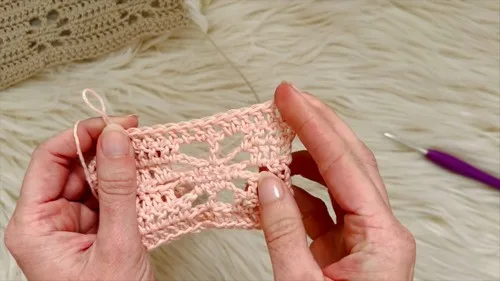
Flat daisy stitch panel, chain multiples of 15, 4mm hook, DK cotton, floral openwork trim.
Crochet Rituals · retyped from the source and laid out for print · added 16 Sep 2026
What the pattern's own author called it. Nothing here is graded again.

What the sample was worked in. Any weight works; the size moves with it.
Each one is typed out whole and gets its own line.
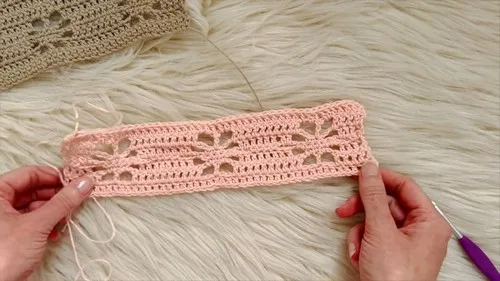
This piece is a flat panel built from a foundation chain in multiples of 15, worked entirely in rows of treble crochet (UK term, equal to US double crochet). The open, spaced stitch pattern reads as a floral motif once blocked, making it suited to garment trims, shawl edges, or standalone panels. Before starting, have DK cotton yarn and a 4mm hook ready.
Listed by the pattern's own author, in their words.
Key to this pattern, 4 short forms
UK Treble Crochet (equivalent to US Double Crochet)
UK Double Crochet (equivalent to US Single Crochet)
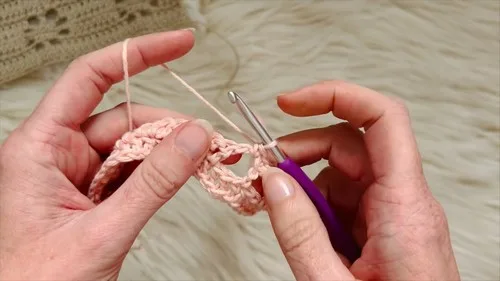
Instructions Starting Chain: Create a slip knot and place it on your hook.
Chain in multiples of 15. For this tutorial, chain 45.
Add 2 more chains for turning (these do not count as a stitch).
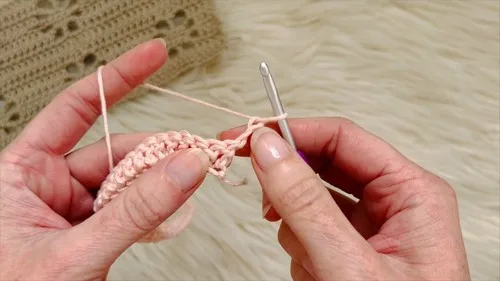
Work a UK treble crochet (US double crochet) into the third chain from the hook, making sure to insert the hook into the back bumps of the chain.Continue working a treble crochet into each chain across the row.Double-check your stitch count; it should match your starting chains minus the extra 2 (e.g., 45 stitches).
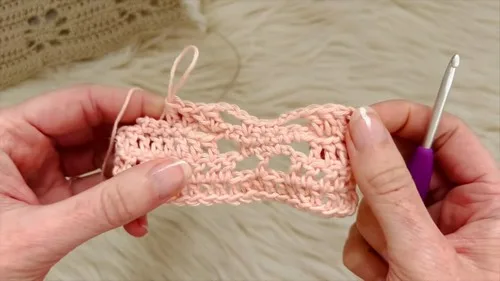
Chain 2 (this counts as a stitch) and turn your work. Work a treble crochet into the next space (not the one directly beneath the chain 2, but the one after that) and into the next 3 stitches. You should have 5 stitches including the turning chain.Chain 2, skip 2 stitches, then work a treble crochet into the next stitch.Chain 2 again, skip another 2 stitches, then work 5 treble crochets.Repeat this pattern across the row, ending with the specified stitch pattern.
Chain 2 and turn. This counts as the first treble crochet.For Row 3: Chain 2 and turn. This counts as the first treble crochet.Work another 3 treble crochets. You've reduced to 4 stitches from 5 at each pattern's start.Chain 3, then work a UK double crochet (US single crochet) in the following sequence: into the chain space, into the top of the treble crochet from the previous row, and into the next chain space.Continue the set pattern across the row.
Chain 1 and turn. Work double crochets, starting directly under the chain. In this row, the chain does not count as a stitch.
Increasing Stitches (Row 5 onward):
You will begin increasing stitches on the sides where the pattern had previously decreased, ensuring symmetry in the pattern as you develop further daisies.
Continue following the pattern's increases and decreases as outlined for creating the full Daisy Stitch effect.
To Continue: Repeat the pattern from the beginning (after the initial chain) to add more rows and expand your project.
| Rounds | 4 |
|---|---|
| Level | Beginner |
| Time | 4-6 hours |
| Hook | 4 mm |
| Yarn | DK |
The foundation chain is worked in multiples of 15 plus 2 turning chains, which sets the repeat length that carries through every subsequent row.
Row 2 breaks from straight treble crochet into a skip-2, chain-2 rhythm after the first 4 stitches, and this spacing is what produces the daisy-like openwork rather than a solid fabric.
| Foundation chain and row 1 | about 20-30 minutes because all 45 stitches are worked as single trebles into the back bumps |
|---|---|
| Row 2 shaping row | about 15-20 minutes because the chain-2 turn and skip-2 spacing take extra attention on a first pass |
| Remaining rows to complete the panel | about 3-4 hours because the 15-stitch repeat carries across all remaining rows |
Every one was taken by whoever published the pattern, in the order the source listed them.
These answers came from whoever first published the pattern, kept word for word.