Beginner
What the pattern's own author called it. Nothing here is graded again.
 Crochet·Rituals
Scarves 5 Laid out for paper No account, no download
Two-tone DC panel, SC mesh fringe, Tunisian scarf. 5.5mm, 8mm hooks. 2-3 row repeats.
Crochet Rituals · retyped from the source and laid out for print · added 6 Oct 2026

What the pattern's own author called it. Nothing here is graded again.
What the sample was worked in. Any weight works; the size moves with it.
Each one is typed out whole and gets its own line.
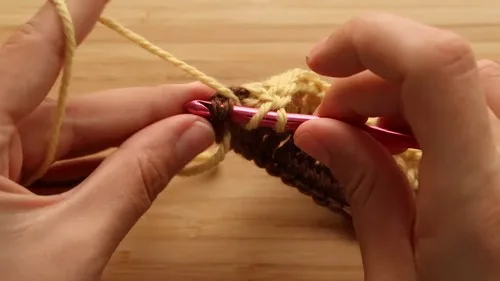
This collection gathers three fast scarf builds: a two-color double crochet panel with a treble crochet accent worked two rows below, an open single crochet mesh finished with fringe, and a Tunisian simple stitch panel built on a forward-and-return pass. Each works flat, row by row, from a foundation chain. Before starting, have both colors of worsted weight yarn wound and ready for the two-tone panel, bulky yarn on hand for the 8 mm hook version, and the Tunisian hook with its cord and stopper ready for the slip-stitch cast-off.
Listed by the pattern's own author, in their words.
Key to this pattern, 10 short forms
Color A Work double crochet in back bump of each chain, switch to Color B at end, chain 1 and turn
Color B Work double crochet in front loops only across row, last stitch through both loops, switch to Color A, chain 1 and turn
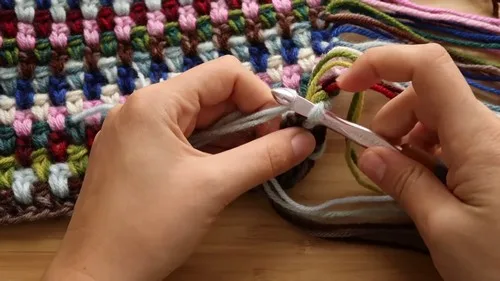
Color A First stitch double crochet through both loops, then repeat one treble crochet into skipped stitch from two rows below, skip one stitch, three double crochet in back loops only, finish with double crochet through both loops, switch to Color B, chain 1 and turn
Row 4 Color B Repeat the same pattern as Row 3 but using Color B, switch to Color A at the end Repeat alternating Row 3 and Row 4 until desired length is reached
Work single crochet in second chain from hook, chain 1, skip one chain, repeat single crochet and chain 1 pattern across, finish with single crochet, switch color, chain 2 and turn
Work single crochet in first chain space, chain 1, skip next stitch, repeat single crochet in chain space followed by chain 1, finish with single crochet in last chain space, switch color, chain 2 and turnRepeat alternating rows with color changes until desired width is reached
Fringe Tie yarn ends at edges into knots for fringe effect, add extra strands to edges, comb and trim to desired length
| Rounds | 5 |
|---|---|
| Parts | 2 |
| Level | Beginner |
| Time | 3-5 hours |
| Hook | 5.5 mm |
| Yarn | Worsted |
In the two-tone panel, the treble crochet worked into the stitch skipped two rows below is what creates the vertical texture column — it only reads clearly because Row 3 and Row 4 alternate color, so the treble always sits in the opposite color from the row it's worked in.
The single crochet mesh is built entirely on chain-1 spaces rather than solid stitches, which is why it can take fringe directly at the edge without a separate foundation — the open structure already has somewhere for the knots to sit.
| Two-color double crochet and treble panel | about 2 hours because the pattern repeats only two rows (Row 3 and Row 4) but each requires tracking loop placement and a two-row-back treble |
|---|---|
| Single crochet mesh with fringe | about 1.5 hours because the row repeat is just two rows, with most of the remaining time going to tying and trimming fringe |
| Tunisian simple stitch panel | about 1.5 hours because the forward-and-return pass takes longer per row than a standard crochet row, even though the stitch pattern itself does not change |
Every one was taken by whoever published the pattern, in the order the source listed them.

These answers came from whoever first published the pattern, kept word for word.