
Intermediate
What the pattern's own author called it. Nothing here is graded again.
 Crochet·Rituals
Sweaters 12 Laid out for paper No account, no download
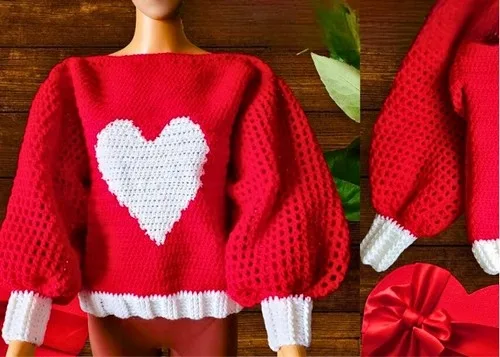
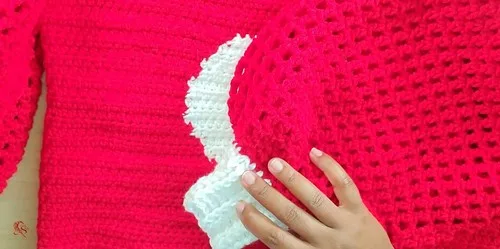
Pullover with heart panels, 4-round ribbed cuffs and mesh sleeves. 5.5mm body hook, 6.0mm sleeve hook.
Crochet Rituals · retyped from the source and laid out for print · added 6 Oct 2026
What the pattern's own author called it. Nothing here is graded again.
What the sample was worked in. Any weight works; the size moves with it.
Each one is typed out whole and gets its own line.
This pullover is built from two identical front and back panels, each carrying an intarsia heart worked in a contrast color against the main shade, then joined with a ribbed hem, a mesh sleeve, and a shoulder closure. Panels start from a 61-chain foundation worked flat in hdc, so the heart shaping sits in the body of the fabric rather than added after. Before picking up the hook, have both colors wound and ready, a 5.5 mm hook for the panels and ribbing, a 6.0 mm hook for the sleeves, and stitch markers on hand for the armhole and neck measurements.
Listed by the pattern's own author, in their words.
Key to this pattern, 7 short forms
Make a slip knot and chain 61
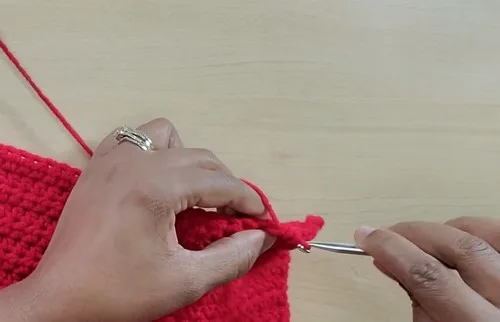
skip first chain and work 1 hdc in each back bump across 60 hdc
to 9 ch 1 turn work hdc in each stitch across Creating the Heart Motif Use intarsia color change technique switch colors on final yarn over
work 29 hdc in MC change to CC work 2 hdc change to MC work 29 hdc
to 29 increase CC stitches and decrease MC based on pattern countsRow 30 form top of heart with 8 CC 4 MC 8 CC Row 31 6 CC 6 MC 6 CC Row 32 4 CC 8 MC 4 CC
work sc into dc stitches skipping chain spacesRow 2 sc2tog around to reduce
work sc around fasten MC join CC
ch 2 work dc around 24 dc join
to 11 repeat 2 FPDC and 2 BPDC around for 7 rib rows Fasten off and weave endsCrochet Heart Sweater
Switch to 6 mm hook Join MC at underarm work sc around join
to 25 ch 4 dc ch1 repeat around for mesh stitch join each round
to 46 ch 1 turn work 14 rows of hdc all MC
ch 2 skip 1 stitch repeat ch1 skip1 hdc
to 50 ch 1 turn work 3 rows sc across
| Rounds | 12 |
|---|---|
| Parts | 4 |
| Level | Intermediate |
| Time | 4-6 hours |
| Hook | 5.5 mm |
| Yarn | Worsted |
The heart motif is built through a gradual stitch-count shift: Row 10 splits the row into 29 MC hdc, 2 CC hdc, and 29 MC hdc, then Rows 11 to 29 increase the CC count and decrease the MC count each row, which is what grows the motif's width as the panel climbs.
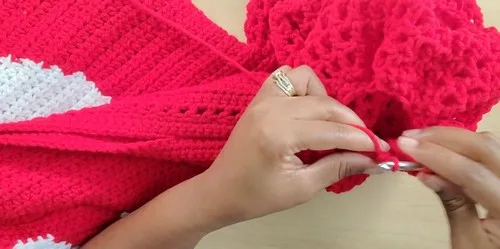
The panels are worked flat rather than in the round because the intarsia technique requires turning at the end of each row to carry both yarns correctly on the wrong side; the mesh sleeves and ribbing, by contrast, are joined rounds since no color carrying is needed there.
| Sweater Panels (Make 2) | about 2 to 3 hours per panel because of the 29-row length and the intarsia color tracking through the heart shaping |
|---|---|
| Sleeve Cuff Ribbing and Sleeves (Make 2) | about 45 minutes per sleeve because the cuff's 11 rows are short but the mesh body runs 24 rounds |
| Top Body Section and assembly | about 1 hour because the 3 rounds are quick, but the armhole and shoulder seaming need careful measuring to the 8-inch and 12-stitch marks |
Every one was taken by whoever published the pattern, in the order the source listed them.
These answers came from whoever first published the pattern, kept word for word.