Beginner
What the pattern's own author called it. Nothing here is graded again.
 Crochet·Rituals
Blankets & Throws 3 Laid out for paper No account, no download
150-stitch grit stitch afghan, 179 rows, 6mm hook, three-round border, five-color autumn palette.
Crochet Rituals · retyped from the source and laid out for print · added 23 Oct 2026
What the pattern's own author called it. Nothing here is graded again.
What the sample was worked in. Any weight works; the size moves with it.
Each one is typed out whole and gets its own line.
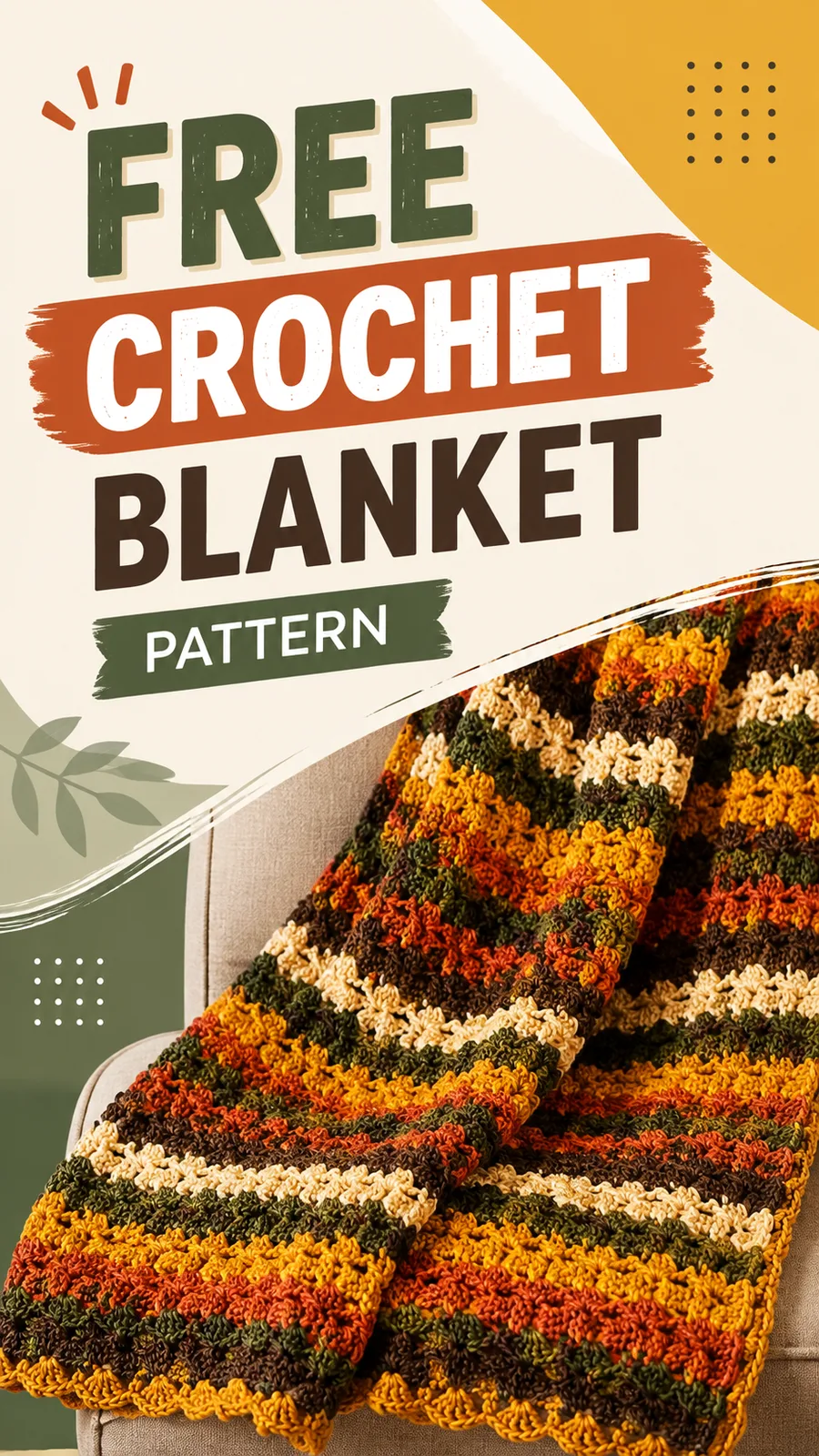
This afghan is built on a 150-stitch foundation worked in a two-stitch grit stitch repeat of single crochet and double crochet, row after row, for 179 rows before the border. The fixed stitch count means every row reads the same once the first few are memorized. Five colors in burnt orange, mustard gold, olive green, deep brown, and warm cream move through the body in short, irregular stripes. Have a 6 mm hook, around 2,700 to 3,000 yards of medium weight yarn, a yarn needle, and locking stitch markers on hand before starting.
Listed by the pattern's own author, in their words.
Key to this pattern, 8 short forms
, RS: Sc in 2nd ch from hook and in every ch across. Turn. 150 sc.
, WS: Ch 1, working into the first st, (1 sc, 1 dc) in first st, skip next st; *work (1 sc, 1 dc) in next st, skip next st*. Rep from * to * 74 more times across. Turn. 150 sts, consisting of 75 grit pairs.
, RS: Ch 1. Work (1 sc, 1 dc) in the first sc of the previous row, skip the following dc; *work (1 sc, 1 dc) in next sc, skip next dc*. Rep from * to * 74 more times. Turn. 150 sts.Rows 4 through 179: Repeat Row 3, maintaining 150 stitches on every row and following the color sequence below.At the suggested gauge, 179 total body rows create approximately 59 to 60 in / 150 to 152 cm of blanket length before the border. If your row gauge differs, work fewer or additional complete rows until the body is close to your preferred length.
For a warm woodland-inspired blanket, divide your yarn approximately as follows: Color A, Burnt Orange: 650 yd / 594 m Color B, Mustard Gold: 600 yd / 549 m
Color C, Olive Green: 600 yd / 549 m Color D, Deep Brown: 750 yd / 686 m Color E, Warm Cream: 300 yd / 274 m
These quantities include some allowance for the border and normal variation in gauge. You can substitute any five colors you enjoy.
Grit pair: Work 1 sc and 1 dc into the same stitch.
Each grit pair creates two stitches. The next stitch is skipped before another pair is made. Across a 150-stitch row, you will make 75 grit pairs for a total of 150 stitches.
With Color A, ch 151 .
The main blanket requires an even number of working stitches. The extra chain provides the turning chain for the foundation row.
For a varied, organic appearance, change colors in bands of different depths. Work the following 22-row color sequence:
Rows 2 to 4: Color A, Burnt Orange, 3 rows.
Rows 5 to 7: Color C, Olive Green, 3 rows.
Rows 8 to 9: Color B, Mustard Gold, 2 rows.
Rows 10 to 13: Color D, Deep Brown, 4 rows.
Rows 14 to 15: Color E, Warm Cream, 2 rows.
Rows 16 to 19: Color A, Burnt Orange, 4 rows.
Rows 20 to 22: Color C, Olive Green, 3 rows.
Row 23: Color B, Mustard Gold, 1 row. Repeat Rows 2 to 23 color placement 8 times total . Eight repeats equal 176 textured rows. Together with Foundation Row 1, you now have 177 rows .
Row 178: With Color D, repeat Row 3. 150 sts.
Row 179: With Color A, repeat Row 3. 150 sts. Do not fasten off if using Color A for the first border round.
On the final double crochet of the row before a color change, begin the stitch normally. Yarn over, insert hook, yarn over and pull up a loop, yarn over and pull through two loops. Before the final yarn over, drop the old color. Yarn over with the new color and pull it through the remaining two loops.
Turn, ch 1, and continue with the new color.
If a color will not be used again within the next few rows, cut it leaving a tail approximately 6 in / 15 cm long. Weave the tails securely into stitches of the same color after completing several more rows.
The border gives the afghan a cleaner outline and helps stabilize the textured edges. Exact side-edge stitch placement can vary slightly with individual row height, so the goal is a flat edge rather than forcing a rigid number of stitches along the long sides.
With Color A and RS facing, ch 1. Sc evenly around the entire blanket. Work approximately 1 sc into the end of each row along the long sides, adjusting slightly if necessary so the edge lies flat. Work 3 sc in each corner . Along the foundation and final edges, work 1 sc in each stitch. Join with sl st to the first sc. Do not turn.
Change to Color D. Ch 1, sc in each st around, working 3 sc in the center corner stitch at each corner. Join with sl st to first sc. Do not turn.
Change to Color B. Ch 1, sc in each st around, again working 3 sc in each corner’s center stitch. Join with sl st to first sc.
Fasten off, leaving a 6 in / 15 cm tail.
| Rounds | 3 |
|---|---|
| Parts | 11 |
| Level | Beginner |
| Time | 20-30 hours |
| Hook | 6 mm |
| Yarn | Worsted |
The foundation row creates exactly 150 single crochet stitches, and the Main Pattern converts these into 75 grit stitch pairs without adding or removing any stitches, which is why every row from Row 3 through Row 179 holds steady at 150 stitches.
The piece is worked flat with a turn at the end of every row rather than joined in rounds, which keeps the right side and wrong side of the grit stitch alternating in a way that still reads as one continuous texture from the front.
| Foundation Row | about 20-30 minutes because it is a single row of 150 sc to set up the full width |
|---|---|
| Main Pattern body, Rows 2-179 | about 18-25 hours because 178 rows of grit stitch and color changes make up nearly the entire blanket |
| Three-round border | about 1-2 hours because the border covers all four sides in three passes before blocking |
These answers came from whoever first published the pattern, kept word for word.