Skip to the patterns
Crochet·Rituals
Menu

Amigurumi 60 Laid out for paper No account, no download

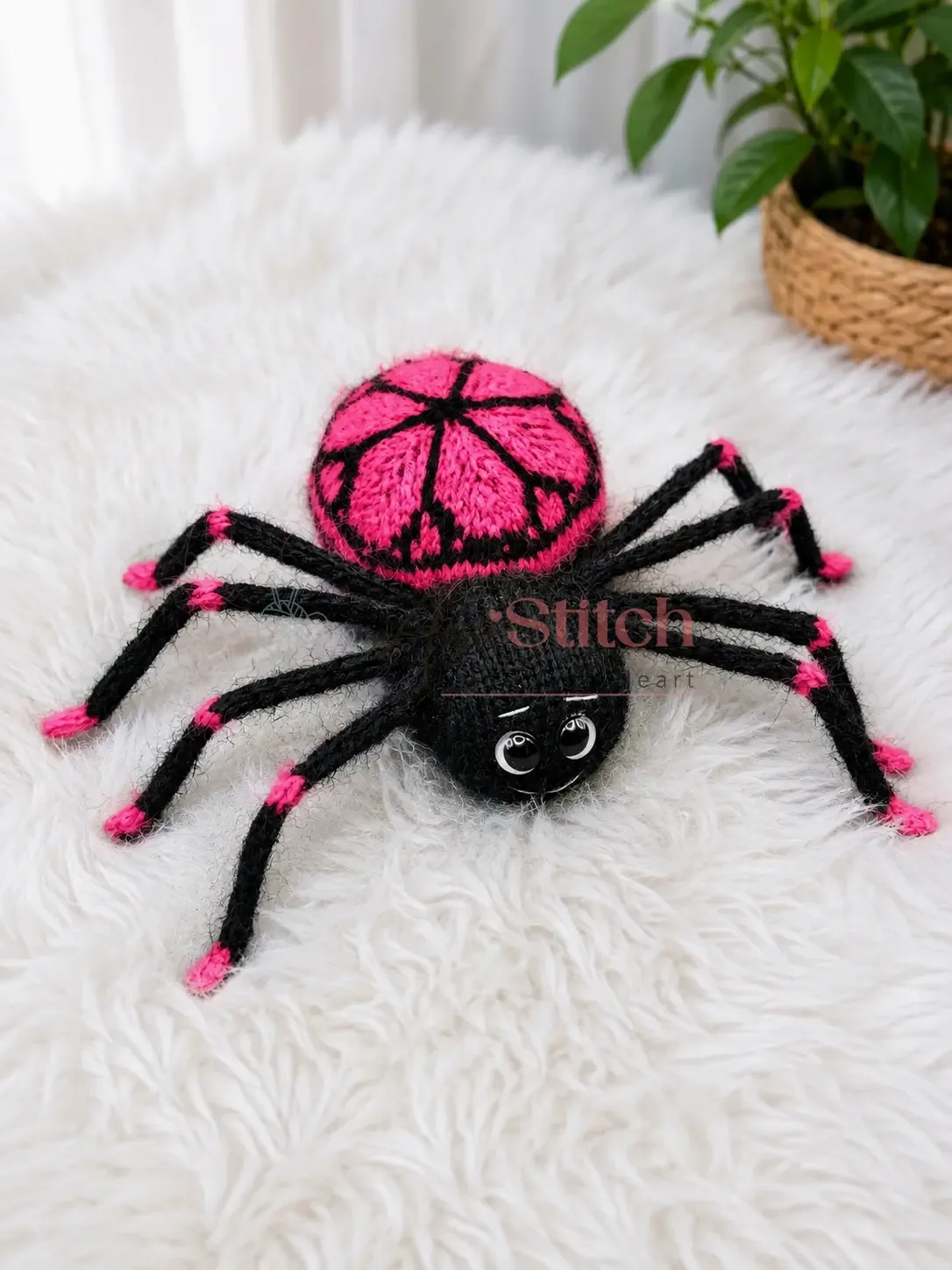
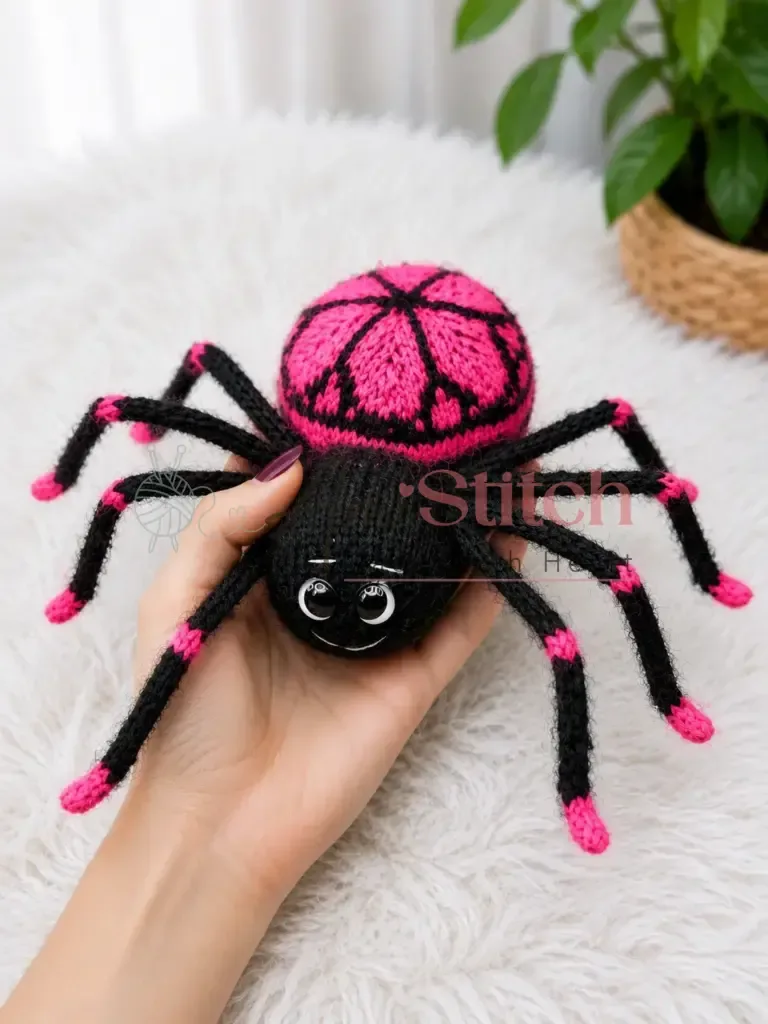
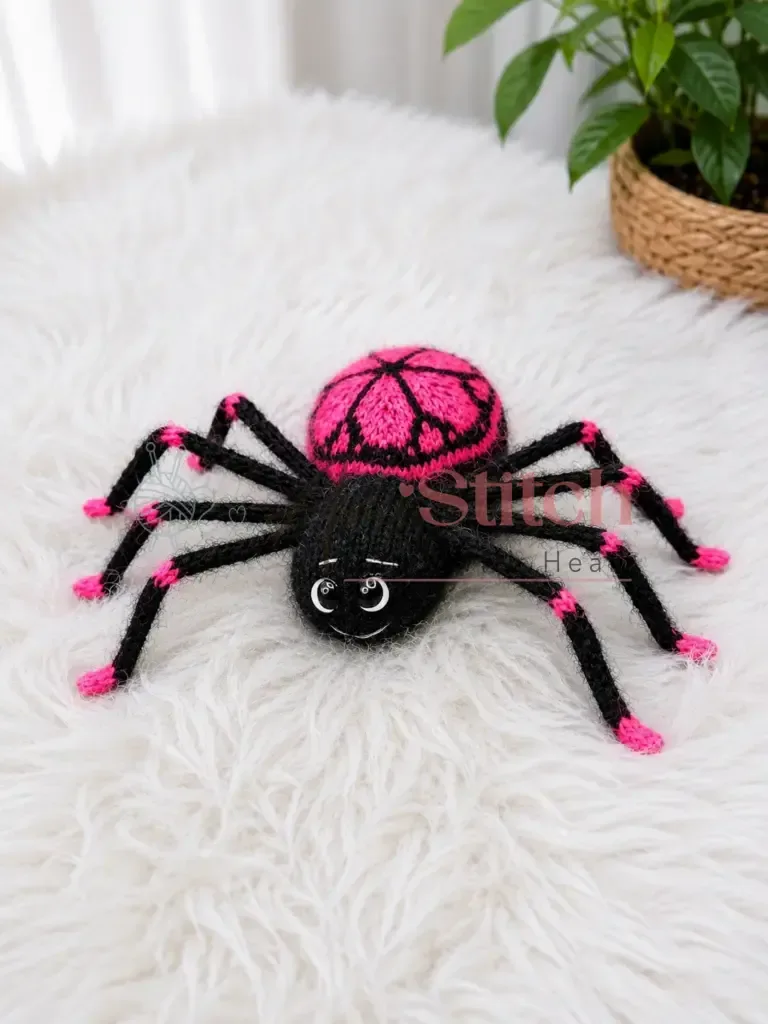
Pink and black spider amigurumi with poseable wire legs

Two-color amigurumi spider, 32-round body, 21-round head, wire-core legs on US 000 needles.

Jump to the rounds Pin it
Pink and black spider amigurumi with poseable wire legs
Amigurumi · Lace
Skill
Intermediate
Time
6-8 hours
Yarn weight
Lace
Hook
1.5 mm
Rounds
60

Intermediate

What the pattern's own author called it. Nothing here is graded again.

Lace

What the sample was worked in. Any weight works; the size moves with it.
60

Each one is typed out whole and gets its own line.

This two-color amigurumi spider is built entirely in the round on a circular needle using Magic Loop and finishes at about 7 cm (2.75 in). The abdomen grows from 6 to 90 stitches through a pink-and-black colorwork sequence, then continues in black; a waste-yarn marker at Round 6 holds the opening later picked up for the head. The head is knit from those held stitches, set with 8 mm safety eyes, and stuffed firmly. Four wire-cored i-cord legs, worked on double-pointed needles, are closed at the tips and cross-anchored through the head in pairs. Have both colors, both needle types, and the floral wire ready before starting.

Common mistakes and their fixes

Treating knit abbreviations as crochet stitches
dec-L, dec-R, inc, and inc-R are paired knit decreases and increases (ssk, k2tog, M1, kfb); work them on needles exactly as listed, not as crochet decreases.
Cutting yarn at every color change
Carry the unused color across the round as noted inline in each round; cut yarn only where the pattern explicitly says to.
Losing track of the waste-yarn leg stitches
Place the contrasting waste yarn precisely at Round 6 as instructed — these 16 stitches are the exact ones picked up later for the head and leg openings.

The materials list

Yarn

  1. Any yarn weight of your choice — yarn thickness determines finished size. The original was worked in single-strand mink-fiber laceweight yarn. You’ll need black and pink (or any two contrasting colors).

Needles

  1. US size 000 (1.5 mm) circular needle with an 80 cm / 32 in cable (for Magic Loop), plus a set of US size 000 (1.5 mm) double-pointed needles for i-cord legs

Safety eyes

  1. 8 mm, 1 pair

Stuffing

  1. Polyester fiberfill

Other Supplies

  1. 0.8 mm diameter (use slightly thicker wire if your yarn is heavier weight)
  2. Yarn needle / tapestry needle
  3. Scissors
  4. Stitch markers (optional, to track pattern repeats)
  5. Contrasting waste yarn (for the leg opening in Round 6 of the body)

Listed by the pattern's own author, in their words.

Key to this pattern, 8 short forms

Body (Abdomen)

Cast on using Judy's Magic Cast-On: 3 + 3 stitches (6 total). Alternatively, cast on 6 stitches using a Magic Ring equivalent. All color changes within a round are noted inline.

Round 1

6 k (black). (6)

Round 2

(1 k (black), inc (pink)) repeat 6 times. (12)

Round 3

(1 k (black), inc-R (pink)) repeat 6 times. (18)

Round 4

(1 k (black), 1 k, inc, 1 k (pink)) repeat 6 times. (24)

Round 5

(1 k (black), 1 k, inc-R, 1 k (pink)) repeat 6 times. (30)

Round 6

(1 k (black), 2 k, inc, 2 k (pink)) repeat 6 times. (36)

Round 7

(1 k (black), 2 k, inc-R, 2 k (pink)) repeat 6 times. (42)

Round 8

(1 k (black), 3 k, inc, 3 k (pink)) repeat 6 times. (48)

Round 9

(1 k (black), 3 k, inc-R, 3 k (pink)) repeat 6 times. (54)

Round 10

(2 k (black), 3 k, inc, 3 k (pink), 1 k (black)) repeat 6 times. (60)

Round 11

(1 k (pink), 2 k (black), 2 k, inc-R, 2 k (pink), 2 k (black)) repeat 6 times. (66)

Round 12

(2 k (pink), 2 k (black), 2 k, inc, 2 k (pink), 2 k (black), 1 k (pink)) repeat 6 times. (72)

Round 13

(2 k (pink), 1 k (black), 1 k (pink), 2 k, inc-R, 2 k (black), 1 k (pink), 1 k (black), 1 k (pink)) repeat 6 times. (78)

Round 14

(7 k, inc, 6 k (black)) repeat 6 times. (84)

Round 15

(7 k, inc-R, 6 k (pink)) repeat 6 times. (90)

The colorwork pattern is now complete. You have 90 stitches on the needle. Continue in black only.

Rounds 1–5

90 k (black). (90)

Round 6

Knit 16 stitches with a length of contrasting waste yarn, then slide those 16 stitches back to the left needle and re-knit them with the main black yarn. Continue knitting the remaining 74 stitches in black. (90)

These 16 waste-yarn stitches mark where the legs will be attached later.

Rounds 7–9

90 k. (90)

Round 10

(dec-L, 11 k, dec-R) repeat 6 times. (78)

Round 11

78 k. (78)

Round 12

(dec-L, 9 k, dec-R) repeat 6 times. (66)

Round 13

66 k. (66)

Round 14

(dec-L, 7 k, dec-R) repeat 6 times. (54)

Round 15

54 k. (54)

Round 16

(dec-L, 5 k, dec-R) repeat 6 times. (42)

Round 17

42 k. (42)

Round 18

(dec-L, 3 k, dec-R) repeat 6 times. (30)

Round 19

30 k. (30)

Round 20

(dec-L, 1 k, dec-R) repeat 6 times. (18)

Round 21

18 k. (18)

Round 22

(k3tog) repeat 6 times. (6)

Round 23

6 k. (6)Thread a yarn needle with the tail, draw through all 6 remaining stitches, pull tight to close, and weave in the end securely.

Head

Pick up the 16 + 16 stitches held on waste yarn from the leg-opening round (32 stitches total). Distribute them onto your Magic Loop needle. Begin knitting from the back (patterned/abdomen side) of the spider.

Round 1

(16 k) × 2 = 32 k. (32)

Round 2

inc-R, 14 k, inc-R + 16 k. (34)

Round 3

1 k, inc-R, 14 k, inc-R, 1 k + 16 k. (36)

Round 4

2 k, inc-R, 14 k, inc-R, 2 k + 16 k. (38)

Round 5

3 k, inc-R, 14 k, inc-R, 3 k + 16 k. (40)

Round 6

4 k, inc-R, 14 k, inc-R, 4 k + 16 k. (42)

Round 7

5 k, inc-R, 14 k, inc-R, 5 k + 16 k. (44)

Rounds 8–11

28 k + 16 k. (44)Place safety eyes at this stage, positioning them symmetrically on the front half of the head (the 28-stitch needle half). Use the 14 center stitches as a guide for even placement.

Round 12

5 k, dec-L, 14 k, dec-R, 5 k + 16 k. (42)

Round 13

4 k, dec-L, 14 k, dec-R, 4 k + 16 k. (40)

Round 14

3 k, dec-L, 14 k, dec-R, 3 k + 16 k. (38)

Round 15

2 k, dec-L, 14 k, dec-R, 2 k + 16 k. (36)

Round 16

1 k, dec-L, 14 k, dec-R, 1 k + 16 k. (34)

Round 17

dec-L, 14 k, dec-R + 16 k. (32)

Round 18

(dec-L, 12 k, dec-R) × 2. (28)

Round 19

(dec-L, 10 k, dec-R) × 2. (24)

Round 20

(dec-L, 8 k, dec-R) × 2. (20)Stuff the head and body firmly with fiberfill now, before the opening becomes too small to reach.

Round 21

(dec-L, 6 k, dec-R) × 2. (16)

Round 22

(dec-L, 4 k, dec-R) × 2. (12)

Round 23

(dec-L, 2 k, dec-R) × 2. (8)

Round 24

Divide the remaining 8 stitches: 4 stitches on each needle half. Close using Kitchener stitch (grafting). (0)Weave in all yarn ends.

Legs

Each leg is worked as a 4-stitch i-cord on double-pointed needles. Cast on 4 stitches.

Rounds 1–3

i-cord in pink. (4)

Rounds 4–13

i-cord in black. (4)

Rounds 14–15

i-cord in pink. (4)

Rounds 16–45

i-cord in black (30 rounds). (4)

Rounds 46–47

i-cord in pink. (4)

Rounds 48–57

i-cord in black. (4)

Rounds 58–60

i-cord in pink. (4)Cut the yarn, thread a yarn needle through all 4 stitches, pull tight to close. Leave a tail for sewing.Cut a length of floral wire slightly longer than the i-cord. Bend a small loop at each end of the wire — this prevents the wire from poking through the knitting. Thread the wire into the i-cord tube. Using pink yarn, tack the wire's looped ends to the inside of the cord at each tip so the wire is secured at both ends.Fold each leg in half and bend it to form the angled, jointed shape of a spider's leg. Prepare all 4 legs this way.

Assembly, in order

Step 1Arrange the 4 legs in two pairs. Each pair will be attached to one side of the spider's body — 2 legs on the left and 2 legs on the right.
Step 2Position the legs between the head and the abdomen, with the larger portion of each leg attached to the head side.
Step 3Thread a yarn needle and sew straight through the head from one side to the other, pulling the legs on each side toward each other as you stitch. This cross-anchoring technique holds the legs firmly in place without them twisting or shifting.
Step 4When all 4 legs are securely attached, glue or press-fit the 8 mm safety eyes into place on the front of the head. If you haven't already set the eyes on the safety post during knitting, use a yarn needle to carefully pierce through the knitted fabric at your chosen placement.
Step 5If desired, embroider a small mouth and eyebrows using contrasting yarn.
Step 6Weave in any remaining yarn ends.

Check these before you start

  • This pattern uses knitting abbreviations throughout (dec-L, dec-R, inc, inc-R, k, k3tog) rather than crochet stitches; work it on needles as written, not as single or double crochet.
  • Match floral wire thickness to your yarn weight — the 0.8 mm wire specified suits the original laceweight; move up a wire gauge if substituting a heavier yarn.
  • Stuff the head and body while the Magic Loop opening is still wide enough to reach; both openings close quickly once the final rounds are worked.
  • A note for crocheters: This original pattern was written for knitting needles using the Magic Loop method. The techniques described — knit stitches, increases from lifted strands, and paired left/right decreases — are knitting techniques, not crochet. The pattern has been fully translated from Russian and presented here in US English knitting terminology so you can work it exactly as intended.
  • This pattern is written in US knitting terminology.
  • The body and head are worked in the round using the Magic Loop method on a single circular needle. Each round is divided into two halves — Needle 1 and Needle 2 — separated by a + sign where the stitch counts differ (e.g., 18 k + 16 k means 18 stitches on the first needle half and 16 on the second). Where both halves are equal, the count may appear as a single total (e.g., (28 k)*2).
  • Cast on using Judy's Magic Cast-On (3+3), which places 3 stitches on each needle half to begin — this is the knitting equivalent of a Magic Ring start and creates a seamless closed bottom.
  • Stitch counts are given at the end of each round in parentheses: (##).
  • Color abbreviations in the original: b = black, p = pink. Colors are noted inline where they change within a round.
  • The colorwork pattern on the abdomen uses 6 repeating sections around the circumference — place stitch markers if needed to track each repeat.
  • The legs are knitted as i-cord (a 4-stitch tube cord on double-pointed needles) and threaded with floral wire before assembly.
  • Insert safety eyes before closing the head.
  • Use the thinnest wire that still holds a pose. The 0.8 mm floral wire recommended here is the sweet spot for laceweight yarn — bendy enough to pose, stiff enough to hold. If you're using a heavier yarn, step up to 1.0–1.2 mm wire, but test it first: too thick and the wire will distort the i-cord's shape.
  • Keep your knitting tight for a firm body. The colorwork pattern on the abdomen has a lot of short color segments. Carry the unused color loosely along the inside of the round to avoid puckering, but keep your main working tension snug — any looseness will show in the finished surface.

On one line

Rounds60
Parts3
LevelIntermediate
Time6-8 hours
Hook1.5 mm
YarnLace

Set-up

  • Check that you have enough yarn in both colors to carry through 32 rounds of body, 21 rounds of head, and four 7-round legs — the body alone runs to 90 stitches before the solid black section.
  • Cut and set aside the contrasting waste yarn now; it needs to be in place at Round 6 of the body, not located mid-round.
  • Knit a small gauge swatch at US size 000 before casting on — fine laceweight at this needle size behaves differently from heavier gauges and the colorwork increases depend on even tension.
  • Read through the leg color sequence (pink, black, pink, black, pink) before casting on the i-cord so you know where each color block starts without stopping to recheck.

Construction

The body's colorwork increases fall on alternating rounds (Rnd 2, 4, and onward), each pairing a black knit stitch with a pink increase; this keeps the pink spiral visually distinct from the black background as the abdomen grows to 90 stitches.

The head is not cast on separately — it is picked up from the 16 + 16 waste-yarn stitches left at the body's Round 6 leg opening, which means the head and body are joined by construction rather than by a later seam.

Time per section

Body (Abdomen)about 2-3 hours because 32 rounds include a pink-and-black colorwork increase section building to 90 stitches.
Headabout 1.5-2 hours because 21 rounds plus picking up 32 held stitches, placing safety eyes, and stuffing all add handling time.
Legs (×4)about 2-3 hours total because each leg is a separate i-cord with multiple color blocks, wire insertion, and tacking, repeated four times.

Photographs of this one

Every one was taken by whoever published the pattern, in the order the source listed them.
Pink and black spider amigurumi with poseable wire legs — photo 2
Pink and black spider amigurumi with poseable wire legs — photo 3

Common questions

Can this pattern be worked in a heavier yarn than laceweight?
Yes — the materials list allows any yarn weight; just size up the needles accordingly and use slightly thicker floral wire so the legs still hold their pose.
What is the point of sewing through the head during assembly?
Sewing straight through the head while pulling each leg pair toward the other anchors the legs firmly on both sides at once, which keeps them from twisting or splaying apart later.

These answers came from whoever first published the pattern, kept word for word.